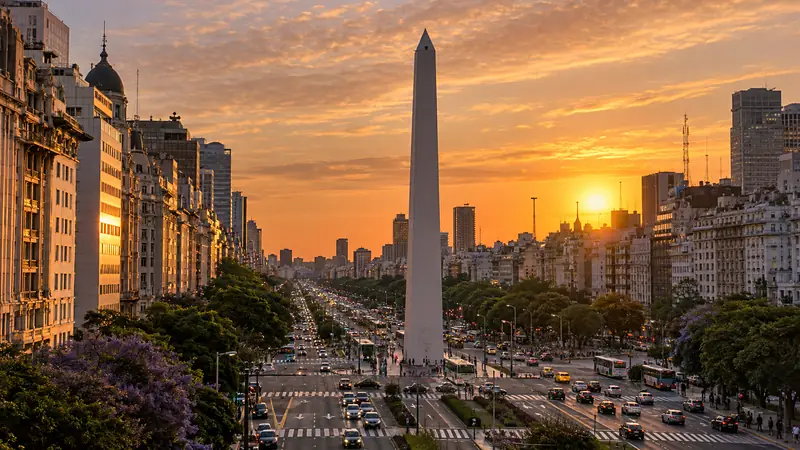
Buenos Aires, Argentina · Argentina
Oslo → Buenos Aires?
A place on our map, not a route. If this is a journey you would realistically consider, tell us — every verified signal shapes what we study next.
The facts, computed today
- Coordinates
- 34.60°S 58.38°W
- Great-circle distance from Oslo
- 12,248 km
- Direction from Oslo
- south-west
- Daylight there today
- 12h 12m
0h 06m more than Oslo
Leave a verified signal for Buenos Aires
Distance and daylight are calculated from the coordinates each time this page is opened. Neither is a route, a schedule or a flight time. Original artwork for this destination. Illustrative, not a photograph of a Vandrer flight.
In short
Buenos Aires
Buenos Aires was founded twice — first by Pedro de Mendoza in 1536, then permanently by Juan de Garay in 1580 — on the south-western shore of the Río de la Plata, the vast estuary that gives its residents their name: porteños, people of the port. Between 1880 and 1930 it was one of the leading destinations for European emigrants, above all from Italy and Spain, and out of that mix of immigrants, descendants of enslaved Africans and criollos grew tango, which UNESCO inscribed in 2009 as a heritage shared with Montevideo across the water.
The city has been formally autonomous since 1994 and counted 3.1 million people at the 2022 census, with close to 14 million in Greater Buenos Aires. Its Teatro Colón, opened in 1908 with some 2,500 seats and reopened after restoration in 2010, is renowned for its acoustics, and the Avenida 9 de Julio through its centre is 140 metres wide.
Why people might travel there
The city of the porteños, on the shore of the Río de la Plata.
At about 12,200 kilometres, Buenos Aires is the end of the long south-westerly line that passes Rio and São Paulo. It is here as a test of reach: the journey where the question of distance is not rhetorical, and where the reward is a city with its own season, its own music and a distinct European–Latin American history.
Humid subtropical in the southern hemisphere: January is the warmest month, averaging around 25 °C and humid; July the coolest at about 11 °C, and snow is rare — the last fell in July 2007. The jacarandas that line so many streets flower in the southern spring.
This is what makes the place interesting. It is not a sign that Vandrer has selected it.
Seasonal interest
Seasonal interest
Not shown yet. A seasonal picture appears only once enough verified signals exist to aggregate safely, never from a handful of votes.
What a vote means
One verified signal per person for this destination. It tells us you would realistically consider the journey. It does not confirm a route, buy anything or subscribe you to marketing.
Updates about this destination
Route updates are a separate choice with their own consent wording: “Tell me if Vandrer publishes an update about this destination.” You can turn it on after your signal is verified, from your secure link. It is never preselected and never part of the vote.
Related exploratory places
- São Paulo São Paulo, Brazil Under consideration Open →
- Rio de Janeiro Rio de Janeiro, Brazil Under consideration Open →
- Cape Town Western Cape, South Africa Under consideration Open →
Sources for the facts in this page: INDEC — Instituto Nacional de Estadística y Censos · UNESCO Intangible Cultural Heritage — Tango · Teatro Colón — the theatre · Argentina.gob.ar — Teatro Colón, 116 years of history · Wikipedia — Buenos Aires