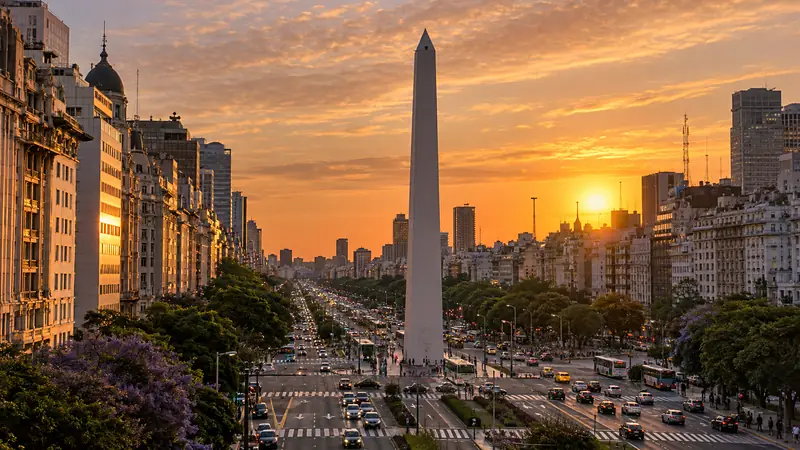
Buenos Aires, Argentina · Argentinien
Von Oslo nach Buenos Aires?
Ein Ort auf unserer Karte, keine Strecke. Wenn das eine Reise ist, die Sie realistisch in Betracht ziehen würden, sagen Sie es uns — jedes bestätigte Signal prägt, was wir als Nächstes untersuchen.
Die Fakten, heute berechnet
- Koordinaten
- 34.60°S 58.38°W
- Großkreisentfernung von Oslo
- 12.248 km
- Richtung von Oslo
- Südwesten
- Tageslicht dort heute
- 12h 12m
0h 06m mehr als in Oslo
Ein bestätigtes Signal für Buenos Aires hinterlassen
Entfernung und Tageslicht werden bei jedem Öffnen dieser Seite aus den Koordinaten berechnet. Beides ist weder eine Strecke noch ein Flugplan oder eine Flugzeit. Eigens für dieses Ziel gestaltete Bildwelt. Illustrativ, kein Foto eines Vandrer-Fluges.
Kurz gefasst
Buenos Aires
Buenos Aires was founded twice — first by Pedro de Mendoza in 1536, then permanently by Juan de Garay in 1580 — on the south-western shore of the Río de la Plata, the vast estuary that gives its residents their name: porteños, people of the port. Between 1880 and 1930 it was one of the leading destinations for European emigrants, above all from Italy and Spain, and out of that mix of immigrants, descendants of enslaved Africans and criollos grew tango, which UNESCO inscribed in 2009 as a heritage shared with Montevideo across the water.
The city has been formally autonomous since 1994 and counted 3.1 million people at the 2022 census, with close to 14 million in Greater Buenos Aires. Its Teatro Colón, opened in 1908 with some 2,500 seats and reopened after restoration in 2010, is renowned for its acoustics, and the Avenida 9 de Julio through its centre is 140 metres wide.
Warum Menschen dorthin reisen könnten
Die Stadt der Porteños, am Ufer des Río de la Plata.
At about 12,200 kilometres, Buenos Aires is the end of the long south-westerly line that passes Rio and São Paulo. It is here as a test of reach: the journey where the question of distance is not rhetorical, and where the reward is a city with its own season, its own music and a distinct European–Latin American history.
Humid subtropical in the southern hemisphere: January is the warmest month, averaging around 25 °C and humid; July the coolest at about 11 °C, and snow is rare — the last fell in July 2007. The jacarandas that line so many streets flower in the southern spring.
Das ist es, was den Ort interessant macht. Es ist kein Zeichen dafür, dass Vandrer ihn ausgewählt hat.
Saisonales Interesse
Saisonales Interesse
Noch nicht gezeigt. Ein saisonales Bild erscheint erst, wenn genügend bestätigte Signale vorliegen, um sie sicher zusammenzufassen — nie aus einer Handvoll Stimmen.
Was eine Stimme bedeutet
Ein bestätigtes Signal pro Person für dieses Reiseziel. Es sagt uns, dass Sie die Reise realistisch in Betracht ziehen würden. Es bestätigt keine Strecke, kauft nichts und meldet Sie zu keiner Werbung an.
Neuigkeiten zu diesem Reiseziel
Streckenneuigkeiten sind eine gesonderte Entscheidung mit eigenem Einwilligungstext: „Sagen Sie mir Bescheid, wenn Vandrer eine Neuigkeit zu diesem Reiseziel veröffentlicht.“ Sie können sie einschalten, sobald Ihr Signal bestätigt ist, über Ihren sicheren Link. Sie ist nie vorausgewählt und nie Teil der Stimme.
Verwandte Orte in Prüfung
- São Paulo São Paulo, Brazil In Prüfung Öffnen →
- Rio de Janeiro Rio de Janeiro, Brazil In Prüfung Öffnen →
- Cape Town Western Cape, South Africa In Prüfung Öffnen →
Quellen für die Fakten auf dieser Seite: INDEC — Instituto Nacional de Estadística y Censos · UNESCO Intangible Cultural Heritage — Tango · Teatro Colón — the theatre · Argentina.gob.ar — Teatro Colón, 116 years of history · Wikipedia — Buenos Aires