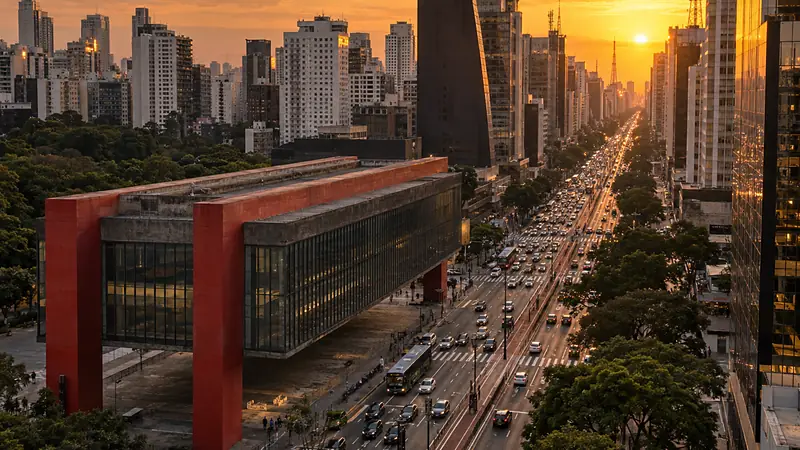
São Paulo, Brazil · Brasilien
Von Oslo nach São Paulo?
Ein Ort auf unserer Karte, keine Strecke. Wenn das eine Reise ist, die Sie realistisch in Betracht ziehen würden, sagen Sie es uns — jedes bestätigte Signal prägt, was wir als Nächstes untersuchen.
Die Fakten, heute berechnet
- Koordinaten
- 23.55°S 46.63°W
- Großkreisentfernung von Oslo
- 10.633 km
- Richtung von Oslo
- Südwesten
- Tageslicht dort heute
- 12h 10m
0h 04m mehr als in Oslo
Ein bestätigtes Signal für São Paulo hinterlassen
Entfernung und Tageslicht werden bei jedem Öffnen dieser Seite aus den Koordinaten berechnet. Beides ist weder eine Strecke noch ein Flugplan oder eine Flugzeit. Eigens für dieses Ziel gestaltete Bildwelt. Illustrativ, kein Foto eines Vandrer-Fluges.
Kurz gefasst
São Paulo
São Paulo was founded on 25 January 1554, when Jesuit priests including Manuel da Nóbrega and José de Anchieta opened a mission school on a hill between two rivers on a plateau some 800 metres above the coast. The village became the most populous city in Brazil and in the Americas: 11.45 million people at the 2022 census, and more than 20 million in the metropolitan area. Millions of its residents have Italian ancestry, and it holds the largest Japanese community outside Japan, descended from immigrants who first arrived at the port of Santos in 1908.
Its landmarks are modern: Avenida Paulista, opened in 1891; MASP, the art museum Lina Bo Bardi lifted onto four pillars over a 74-metre free span, opened in 1968; and Ibirapuera Park with its Oscar Niemeyer pavilions, inaugurated for the city's 400th anniversary in 1954.
Warum Menschen dorthin reisen könnten
Die größte Stadt Amerikas begann als Jesuitenschule auf einem Hügel.
São Paulo is about 10,600 kilometres from Oslo, a little beyond Rio on the same south-westerly line. It is in the catalogue because it is the largest city in the Americas, built by immigration from Italy, Japan, the Arab world and elsewhere — and because an expedition airline should look at where people actually live, not only where they holiday.
Humid subtropical, tempered by altitude. Summers from January to March are hot and rainy, with January averaging nearly 300 mm; winters are mild but cloudy, between roughly 12 and 22 °C, and much drier. The city's fine drizzle, the garoa, is a local institution. Southern hemisphere, so the seasons run opposite to Norway's.
Das ist es, was den Ort interessant macht. Es ist kein Zeichen dafür, dass Vandrer ihn ausgewählt hat.
Saisonales Interesse
Saisonales Interesse
Noch nicht gezeigt. Ein saisonales Bild erscheint erst, wenn genügend bestätigte Signale vorliegen, um sie sicher zusammenzufassen — nie aus einer Handvoll Stimmen.
Was eine Stimme bedeutet
Ein bestätigtes Signal pro Person für dieses Reiseziel. Es sagt uns, dass Sie die Reise realistisch in Betracht ziehen würden. Es bestätigt keine Strecke, kauft nichts und meldet Sie zu keiner Werbung an.
Neuigkeiten zu diesem Reiseziel
Streckenneuigkeiten sind eine gesonderte Entscheidung mit eigenem Einwilligungstext: „Sagen Sie mir Bescheid, wenn Vandrer eine Neuigkeit zu diesem Reiseziel veröffentlicht.“ Sie können sie einschalten, sobald Ihr Signal bestätigt ist, über Ihren sicheren Link. Sie ist nie vorausgewählt und nie Teil der Stimme.
Verwandte Orte in Prüfung
- Rio de Janeiro Rio de Janeiro, Brazil In Prüfung Öffnen →
- Buenos Aires Buenos Aires, Argentina In Prüfung Öffnen →
- Cape Town Western Cape, South Africa In Prüfung Öffnen →
Quellen für die Fakten auf dieser Seite: IBGE — 2022 Census · IBGE Cidades — São Paulo · MASP — about the museum · Wikipedia — São Paulo · Wikipedia — Japanese Brazilians · Wikipedia — Ibirapuera Park