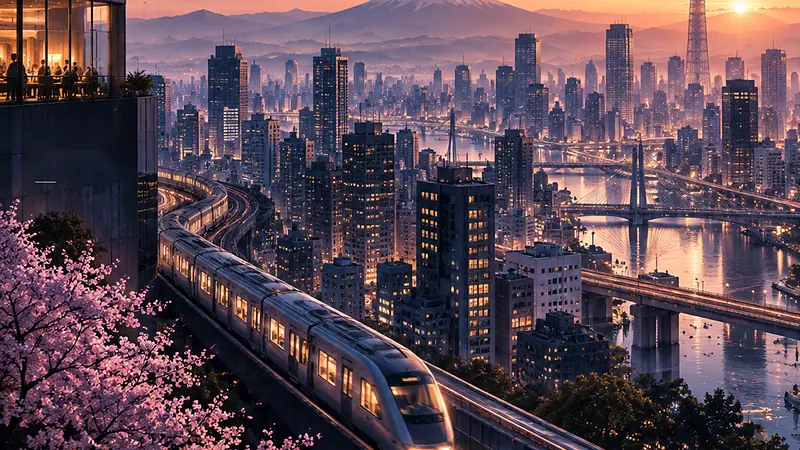
Kantō, Japan · Japan
Von Oslo nach Tokyo?
Ein Ort auf unserer Karte, keine Strecke. Wenn das eine Reise ist, die Sie realistisch in Betracht ziehen würden, sagen Sie es uns — jedes bestätigte Signal prägt, was wir als Nächstes untersuchen.
Die Fakten, heute berechnet
- Koordinaten
- 35.69°N 139.69°E
- Großkreisentfernung von Oslo
- 8.405 km
- Richtung von Oslo
- Nordosten
- Tageslicht dort heute
- 12h 06m
genauso viel wie in Oslo
Ein bestätigtes Signal für Tokyo hinterlassen
Entfernung und Tageslicht werden bei jedem Öffnen dieser Seite aus den Koordinaten berechnet. Beides ist weder eine Strecke noch ein Flugplan oder eine Flugzeit. Eigens für dieses Ziel gestaltete Bildwelt. Illustrativ, kein Foto eines Vandrer-Fluges.
Kurz gefasst
Tokyo
Tokyo lies at the head of Tokyo Bay on the central coast of Honshu. It rose to prominence in 1603 as Edo, seat of the Tokugawa shogunate, and took its present name in 1868 when the Emperor moved his court here and it became the capital of Japan. Today the Tokyo Metropolis counts about 14.3 million people across twenty-three special wards, the Tama hills to the west and a scattering of Pacific islands.
It is a city that has rebuilt itself more than once — after the Great Kantō earthquake of 1923, after the war — and that opened the world's first dedicated high-speed railway, the Shinkansen to Osaka, in 1964, the year it first hosted the Olympics. On clear days the cone of Fuji stands on the western horizon: 3,776 metres, a World Heritage site since 2013, and still the mountain the city measures itself against.
Warum Menschen dorthin reisen könnten
Eine Hauptstadt mit vierzehn Millionen Menschen, die sich noch immer an einem Berg misst.
Tokyo lies roughly 8,400 kilometres from Oslo, on a great circle that crosses the Arctic Circle over northern Russia. It represents the long-haul question in its purest form: the possibility of connecting Oslo more directly with one of Asia's most distinctive destinations.
Humid subtropical: January averages around 5 °C, August close to 27 °C. The rainy season, tsuyu, runs from early June to mid-July, and typhoon activity in the western Pacific peaks in August and September. Winters are comparatively dry and clear.
Das ist es, was den Ort interessant macht. Es ist kein Zeichen dafür, dass Vandrer ihn ausgewählt hat.
Saisonales Interesse
Saisonales Interesse
Noch nicht gezeigt. Ein saisonales Bild erscheint erst, wenn genügend bestätigte Signale vorliegen, um sie sicher zusammenzufassen — nie aus einer Handvoll Stimmen.
Was eine Stimme bedeutet
Ein bestätigtes Signal pro Person für dieses Reiseziel. Es sagt uns, dass Sie die Reise realistisch in Betracht ziehen würden. Es bestätigt keine Strecke, kauft nichts und meldet Sie zu keiner Werbung an.
Neuigkeiten zu diesem Reiseziel
Streckenneuigkeiten sind eine gesonderte Entscheidung mit eigenem Einwilligungstext: „Sagen Sie mir Bescheid, wenn Vandrer eine Neuigkeit zu diesem Reiseziel veröffentlicht.“ Sie können sie einschalten, sobald Ihr Signal bestätigt ist, über Ihren sicheren Link. Sie ist nie vorausgewählt und nie Teil der Stimme.
Verwandte Orte in Prüfung
- Seoul Seoul Capital Area, South Korea In Prüfung Öffnen →
- Bangkok Bangkok, Thailand In Prüfung Öffnen →
- Singapore Singapore In Prüfung Öffnen →
Quellen für die Fakten auf dieser Seite: Tokyo Metropolitan Government — history, geography and population · Tokyo Metropolitan Government — monthly population estimates · UNESCO — Fujisan · Japan Meteorological Agency — Tokyo climate normals 1991–2020 · Japan Meteorological Agency — rainy-season dates, Kanto-Koshin · JMA RSMC Tokyo — typhoon climatology